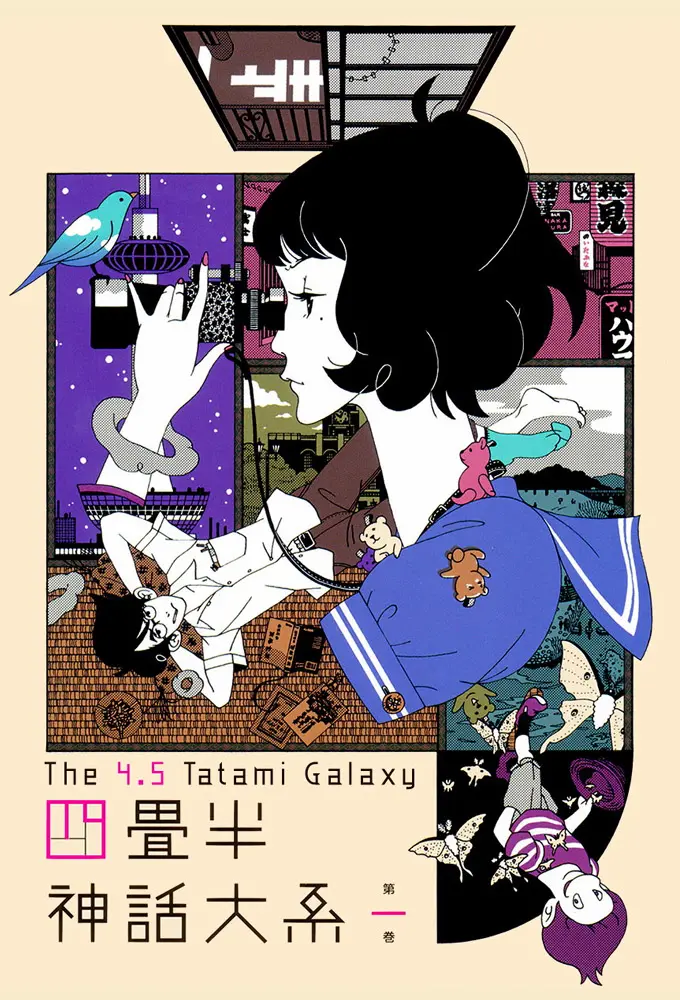
四畳半神話大系 2010 · dir. 湯浅政明
A rewatch: I first watched The Tatami Galaxy when I was about to start my college life. Like the protagonist, I kept asking myself: "what should I do in college?", "should I join clubs?", "sports?", "maybe I should join nothing and focus on getting an A in every class...". Although this anime first aired in 2010, I think it could still relate to people who are just starting college. The main takeaway for me at that time was to take the first step out of my comfort zone and try new things, explore the world, and make mistakes. There are no bad actions/decisions; the worst decision is to not make a decision and hide yourself inside your own world.
Rewatching this anime, I have a different feeling about it. The protagonist always complains about his college life at the end of every episode and believes that if he had chosen another club at the start, he could have had a "better" college life. The first time I watched this anime, I kind of could empathize with him: "yeah, his life is pretty miserable, I might have the same feeling if I were him". After graduating, I have a different feeling when rewatching. His college life is not that miserable; it is actually pretty awesome.
Life can only be understood backwards; but it must be lived forwards.
Although at the end, while he was traversing the Tatami Galaxy, he later concluded there was no such thing as a "rose-colored campus life". But not having a "rose-colored campus life" doesn't mean his campus life was bad; it is just the way he thinks of it. In the original book, the whole story was divided into 4 chapters. Each chapter is a different universe, and each universe has its own happy ending. But in the anime, the transition between each universe was blurry. We don't really see the whole ending in each timeline; instead, we are thrown into the next universe. I really like this adaptation. It feels like we have been on a time machine and time was "rewound" (you could see this being implied in the anime by showing a clock rewinding), instead of jumping directly into another universe, as in the book. Keeping this linear storytelling emphasizes the feeling of "what if...." for the protagonist and for us. If you had such a time machine, would you go back in time and start a different college life?
On Masaaki Yuasa's style
Masaaki Yuasa's style is quite different compared to other anime. The characters' emotions, facial expressions, and body movements are often exaggerated. Some say his style is much more "real" and less like typical anime; you could see the realism in Ping Pong The Animation, and the exaggerated style in Devilman Crybaby. Another film also directed by Masaaki Yuasa, The Night is Short, Walk on Girl, has a similar style (even in character design!) to this anime; both are adapted from books written by the same author, Tomihiko Morimi.